
 FUNDING AND TREASURY
 EFFICIENT ENERGY
 STRATEGIC COLLECTIONS PARTNERSHIP
 WATER MANAGEMENT
 LEGAL ADVISORY
 OUTDOOR ADVERTISING
 SMART TECHNOLOGY

Water tariffs are rising but metering and resilience matter more
A recent article reported that the City of Johannesburg is proposing a significant increase in water tariffs. Whether the final figure lands at 66% or is adjusted through consultation, the broader reality remains clear: water is becoming more expensive, while municipalities continue facing mounting infrastructure and maintenance pressures.
For community schemes, however, the real concern is often not only the rising cost of water, but whether consumption is being measured and allocated accurately in the first place.
Rising tariffs expose existing inefficiencies
Many community schemes still rely on bulk municipal meters, estimated billing, outdated submeters, or allocation methods that don’t accurately reflect actual usage. In a rising tariff environment, every leak, inaccurate reading, and billing assumption becomes significantly more costly.
A further challenge is that councils do not always invoice based on current actual readings. Community schemes may receive averaged municipal accounts for months before being issued with large catch-up invoices once updated readings are processed. This creates serious cashflow and governance risks if schemes have not provisioned conservatively.
The practical reality is simple: schemes should budget based on historic actual consumption trends and maintain provisions for periods where municipal billing is estimated rather than actual.
This becomes particularly important for trustees and managing agents when planning reserve requirements and future maintenance budgets. Water losses and under-recoveries that may previously have seemed manageable can quickly escalate into material financial pressure when tariffs increase sharply. In many cases, schemes only realise the extent of the problem once arrears begin increasing or special levies become unavoidable.
You cannot allocate fairly what you cannot measure
Accurate measurement at both bulk and unit level is essential for responsible water management.
Bulk meters help schemes verify municipal billing, identify losses, and establish reliable consumption baselines. Unit-level meters improve fairness, accountability and cost recovery by ensuring residents are billed according to actual usage rather than estimates or equal allocations.
Water resilience is becoming equally important. Measurement alone does not solve the growing concern around supply interruptions, pressure issues and aging municipal infrastructure.
For many schemes, water security is no longer viewed as a luxury but rather essential infrastructure.
A practical long-term approach
Our approach combines reliable alternative water supply with trusted unit-level accountability.
We provide borehole and filtration solutions supported by solar and battery backup, helping schemes reduce dependence on municipal supply while maintaining operational continuity. Existing borehole infrastructure can also be upgraded and integrated where appropriate.
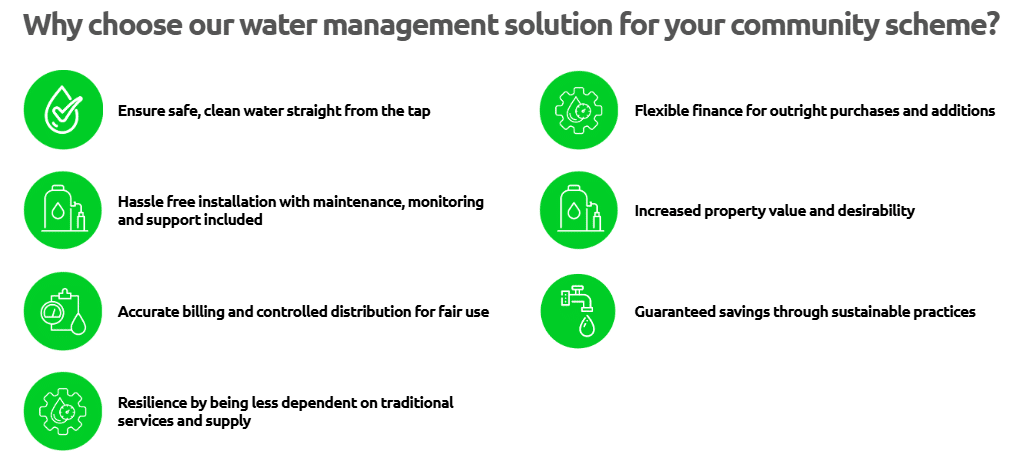
Depending on site conditions and yields, schemes may reduce municipal dependence substantially, while improving long-term cost management and resilience.
To support accurate allocation and recovery, unit-level metering and wallet-based systems can also be implemented to provide transparent consumption reporting and reduce under-recoveries.
Solutions can be implemented in phases or supported through various funding structures, including fully funded utility-style models where schemes only pay for consumption without fixed fees.
In an environment where tariffs continue rising and infrastructure uncertainty remains a growing concern; community schemes can no longer afford reactive water management. Accurate measurement, responsible provisioning, and resilient infrastructure are becoming essential components of sustainable scheme governance. The schemes that plan proactively today will ultimately place themselves in a far stronger operational and financial position for the future.