
 FUNDING AND TREASURY
 EFFICIENT ENERGY
 SMART TECHNOLOGY
 LEGAL ADVISORY
 OUTDOOR ADVERTISING
 WATER MANAGEMENT SOLUTIONS
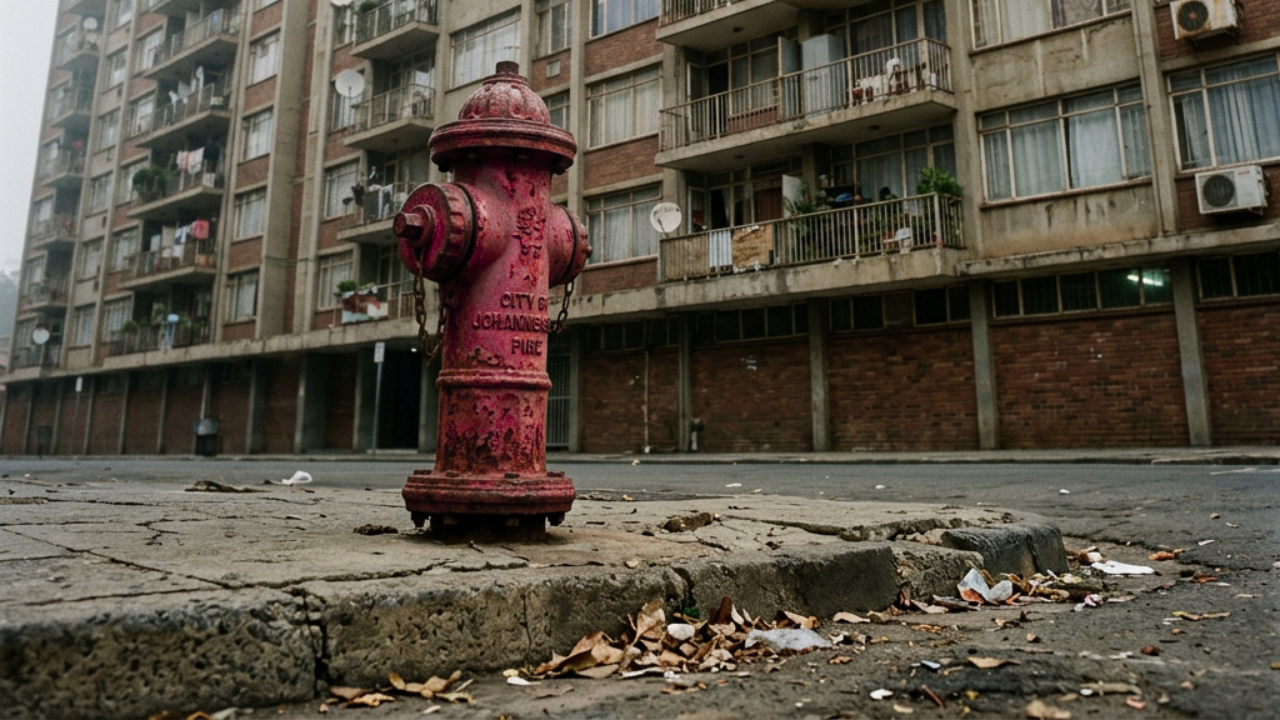
Uninsurable risk: How water failures are reshaping community scheme insurance
Across Johannesburg’s inner city, a quiet but seismic shift is underway. Entire buildings are falling out of the insurance market, not because of claims history or structural shortcomings, but because the infrastructure on which fire risk management depends, has failed. The failure of the infrastructure means that not only is the availability of water not a certainty, but the minimum required pressure to ensure the adequate performance of fire suppression systems is simply not available. A recent Daily Maverick investigation by Anna Cox frames the crisis in commercial terms, but the drivers, failing municipal infrastructure, rising environmental risk, and shrinking insurer capacity, are national in scope and cut across the community schemes sector.
A statutory duty that cannot quietly lapse
Insurance is not discretionary for a body corporate. Section 3(1)(h) of the Sectional Titles Schemes Management Act 8 of 2011 (“STSMA”), read with Prescribed Management Rule (“PMR”) 23, obliges every body corporate to insure the buildings and all improvements to the common property for their full replacement value against prescribed risks, fire chief among them. A scheme without adequate cover is not merely non-compliant, it is exposed at the most fundamental level. The question now confronting the sector is uncomfortable but unavoidable. How does a body corporate comply with a statutory duty to insure against fire risk, when insurers in affected areas are no longer willing to provide that cover on conventional terms, or at all?
Why community schemes are particularly exposed
Sectional title schemes carry several features that increase their potential exposure:
- Schemes are typically multi-storey and high-density, so a single uncontrolled fire carries catastrophic consequences, both human and financial;
- Fire protection systems, sprinklers, hydrants, hose reels, and pressurised risers, depend almost entirely on reliable municipal water supply. Where pressure fails, so too does the system;
- Shared common property means a single uninsured loss is borne collectively by all owners, regardless of whether their individual levies are up to date; and
- Many schemes already operate under financial pressure, with rising arrears and constrained reserves. A premium spike, or the need to self-fund fire infrastructure, lands on already stretched budgets.
An industry that has seen this film before
This is not the first insurer-led shift with sector-wide ramifications. From 2024, schemes with thatch rooves were left scrambling to secure cover, with many electing to replace rooves with insurable alternatives rather than carry exorbitant premiums and ongoing uncertainty. Those structural changes cost schemes millions of Rands and displaced owners while the work was done. The same pattern, cover-driven capital expenditure, is now presenting itself on fire protection infrastructure. Insurers are conducting on-site surveys, requiring compliance with current Automatic Sprinkler Inspection Bureau (“ASIB”) standards, and in some cases insisting on dedicated water storage, booster pumps, and backup power as pre-conditions to cover. The more corrosive consequence is the erosion of property values. If buyers and lenders treat areas as uninsurable, or only insurable at elevated premiums, unit values will fall, and the scheme’s financial resilience will be eroded by market perception alone.
The practical cost of this compliance burden is not hypothetical. Rian Botes of Logos Brokers confirms that a large client of the brokerage was compelled, at its own cost, to install a substantial water reservoir together with pumps calibrated to deliver the pressure required to comply with ASIB standards. That single project ran into millions of Rands, borne entirely by the insured, to retain cover that municipal infrastructure could no longer support. Rian also confirmed that this type of issue is not isolated to Johannesburg, with underwriters becoming increasingly hesitant to even quote on business or property insurance in Pretoria or Durban Central, due to failing infrastructure and service delivery.
Practical steps for trustees and managing agents
The prudent response is to act before the issue arrives at the scheme’s doorstep. Steps worth taking now include:
• Engaging formally with the scheme’s broker and insurer to understand what is covered, what is excluded, and the insurer’s future underwriting appetite;
• Commissioning an independent review of fire protection infrastructure, including water pressure at hydrants and risers, sprinkler functionality, and the condition of pumps and storage;
• Reviewing the 10-Year Maintenance, Repair and Replacement Plan required by PMR 22, and ensuring that fire protection infrastructure is properly provided for;
• Assessing whether the scheme can fund infrastructure upgrades from reserves, or whether structured loan funding is required to avoid a special levy shock; and
• Engaging with owners early and transparently, so that levy adjustments or capital investment decisions are understood rather than resisted.
The case for resilience investment
Reliance on municipal infrastructure, whether for water, electricity, or emergency response, is no longer a safe default. Through Sectional Title Solutions and its partners, schemes can access structured loan funding for fire protection infrastructure and municipal arrears settlement, backup power and solar installations that keep pumps and fire systems running through outages, and water management solutions that address both day-to-day supply and emergency response.
Conclusion
What Johannesburg shows is that municipal infrastructure failure now crosses the threshold from inconvenience to insurability. For trustees, the takeaway is familiar. Delay is not a neutral decision. Schemes that proactively assess their fire protection infrastructure, review their insurance position, and invest in resilience now, will preserve both their compliance posture and their owners’ asset values. Those that wait, until premiums spike, exclusions widen, or cover is withdrawn altogether, will face choices that are neither affordable nor reversible. Risk that is ignored is not risk that disappears. It is, without exception, risk waiting to materialise, and when it does, the cost is always borne collectively.

MATTHEW KAPP
Legal Professional